
How Office Interior Designers Can Select and Apply Custom Curved Linear Lighting
In the realm of modern office design, lighting transcends mere functionality—it shapes ambiance, enhances productivity, and reinforces brand identity. Among the most versatile tools for achieving these goals is **custom curved linear lighting**, a blend of sleek aesthetics and innovative engineering. Here’s a guide for designers on how to strategically choose and implement these fixtures in office spaces.
Why Curved Linear Lighting?
Curved linear lights, a subset of LED linear fixtures, offer unique advantages for office environments:
- Spatial Fluidity: Soft curves break the rigidity of traditional straight lines, creating dynamic visual pathways that guide movement and define zones.
- Ambiance Control: Their directional lighting can highlight architectural features, such as curved walls or reception desks, while minimizing glare on screens.
- Brand Integration: Customizable shapes and colors allow alignment with corporate branding—think curved arcs in a company’s logo color illuminating a lobby.
- Energy Efficiency: LED technology ensures low power consumption and longevity (up to 50,000 hours), critical for 24/7 office operations.
Key Considerations for Selection
A. Size and Scale
- Dimensions: Match the fixture’s length, width, and curvature radius to the office’s spatial constraints. Larger curves suit open-plan areas or atriums, while smaller arcs work for compact zones like corridors.
- Brightness: Opt for higher lumen outputs (e.g., 800–1,200 lm/m) in task-heavy areas like workstations, and softer outputs (500–800 lm/m) for accent lighting
B. Color Temperature
- Neutral to Cool White (3500K–5000K): Enhances focus in collaborative spaces and workstations.
- Warm White (2700K–3000K): Ideal for lounges or breakout areas to foster relaxation.
C. Control Systems
- **Smart Integration**: Use app-controlled or motion-sensing systems to adjust brightness and color temperature dynamically, adapting to meetings, presentations, or after-hours cleaning.
– **Zoning**: Pair with dimmers to create lighting “scenes” for different activities, such as bright lighting for brainstorming sessions and subdued tones for client meetings.
D. Material and Finish
– **Aluminum Housing**: Durable and lightweight, ideal for suspended or recessed installations.
– **Diffusers**: Frosted or prismatic covers ensure uniform light distribution, reducing hotspots in curved designs.
Strategic Applications in Office Spaces
#### **A. Reception and Lobby**
– **Branded Statements**: Install curved linear lights along reception desks or ceiling coves to mirror a company’s logo or architectural curves, instantly conveying professionalism.
– **Wayfinding**: Use sweeping arcs to guide visitors toward elevators or meeting rooms.
#### **B. Collaborative Zones**
– **Ceiling Features**: Suspended curved fixtures above conference tables create focal points while providing glare-free task lighting.
– **Wall Accents**: Backlight curved partitions or whiteboards with RGBW strips to stimulate creativity during brainstorming sessions.
#### **C. Workstations and Private Offices**
– **Desk Integration**: Embed curved LED strips into desk edges or overhead shelves for task lighting that complements ergonomic design.
– **Biophilic Design**: Pair curved lighting with organic-shaped planters or green walls to soften the tech-heavy environment.
#### **D. Corridors and Transitional Spaces**
– **Dynamic Pathways**: Curved linear lights along hallway ceilings or floors can simulate movement, making narrow spaces feel expansive.
Considerations before choosing the best LED spotlights
Beam Angle
The wider the beam angle, the more feathered the brightness. The wide beam angle is ideal for general lighting, providing greater coverage and soft light effects. If you need to illuminate a larger area, such as a living room space or a kitchen counter, choose a wide-beam LED spotlight that can produce even coverage with a beam angle of up to 120°. When more precise lighting is required, such as additional task lighting on a kitchen island or to highlight the display of artwork, it is recommended to choose a narrower beam angle (usually between 20° and 40°). The narrow beam provides focused illumination and is easily adjustable so you can direct the light exactly where you need it. In order to ensure lighting clarity, it is best to choose natural white or cool white LED light sources for the light color in the work area.
Brightness
The power and brightness of an LED bulb are probably the most important parameters. We are used to choosing products that Xu needs from the perspective of watts, because we know that a 60-watt incandescent bulb is brighter than a 40-watt incandescent bulb. However, we should remember that watts measure energy coming in, not energy going out. The same goes for brightness, which is more of a feeling. First, a narrower beam angle will result in higher brightness. A wider beam angle will emit less light, however, what really matters is not the brightness level but the amount of light produced, which is measured in lumens (lm). For general household use, choosing a bulb with a lumen value between 300-800lm is sufficient. Other places can refer to lighting standards and choose lighting products that suit them.
Color Temperature
When we compare LED spotlights to halogen spotlights, we notice a significant difference in the color temperature of the light. LED spotlights give us more color temperature choices, and different color temperatures can create different atmospheres. There are basically three types of color temperature: cool, neutral, and warm, and this feature is measured in Kelvin (K). The higher the number, the cooler the light, while 4000K is an intermediate option for color temperature, often referred to as “neutral white.” 3000K and 3500K are warm lights, suitable for creating a warm lighting environment. 4000K is neutral and has the widest application range. Above 5000K is cold light, suitable for some working environments and improving the user’s mental state.
Installation Tips

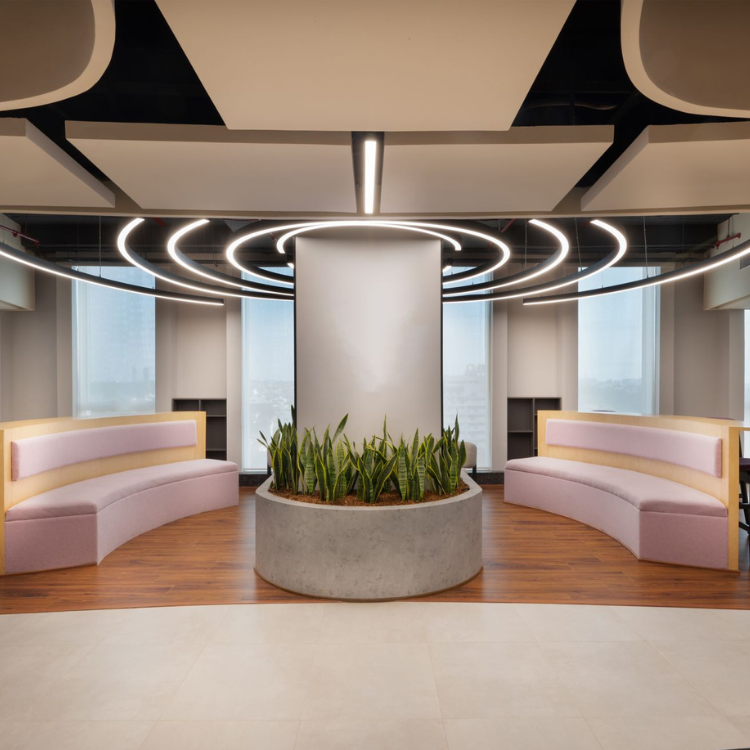

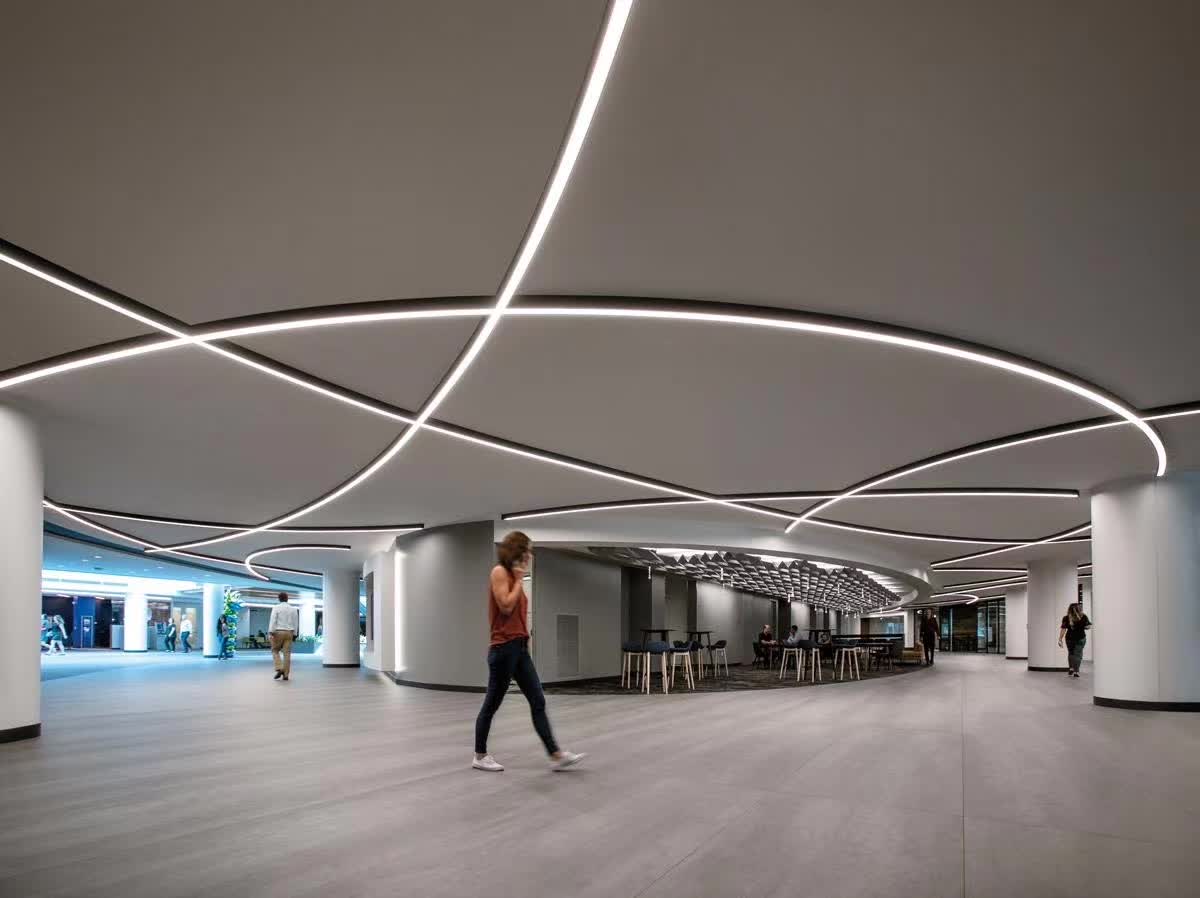
– **Recessed vs. Surface-Mounted**: For minimalist offices, recess curved fixtures into ceilings or walls for a seamless look. Surface mounting works in spaces with exposed industrial aesthetics.
– **Structural Support**: Collaborate with engineers to ensure curved aluminum profiles are securely anchored, especially for large-scale installations.
– **Maintenance Access**: Design removable diffusers or accessible junction boxes for easy LED replacements.
Inspirational Case Studies
– **Tech Startup HQ**: A curved linear chandelier in the lobby, mimicking the company’s circular logo, paired with tunable white lighting to shift from energizing mornings to calming evenings.
– **Co-Working Space**: Undulating ceiling lights in breakout zones, synchronized with motion sensors to brighten when occupants enter.
Final Thoughts
Custom curved linear lighting is more than a trend—it’s a strategic tool for crafting offices that inspire innovation and comfort. By balancing technical specs with creative vision, designers can transform sterile workspaces into dynamic, human-centric environments.
*Looking to integrate curved lighting into your next project? Share your ideas or challenges in the comments below!* 💡
—
**References**: Insights derived from LED linear lighting guides, office design case studies, and technical specifications for commercial installations.

Leave A Comment